学术活动
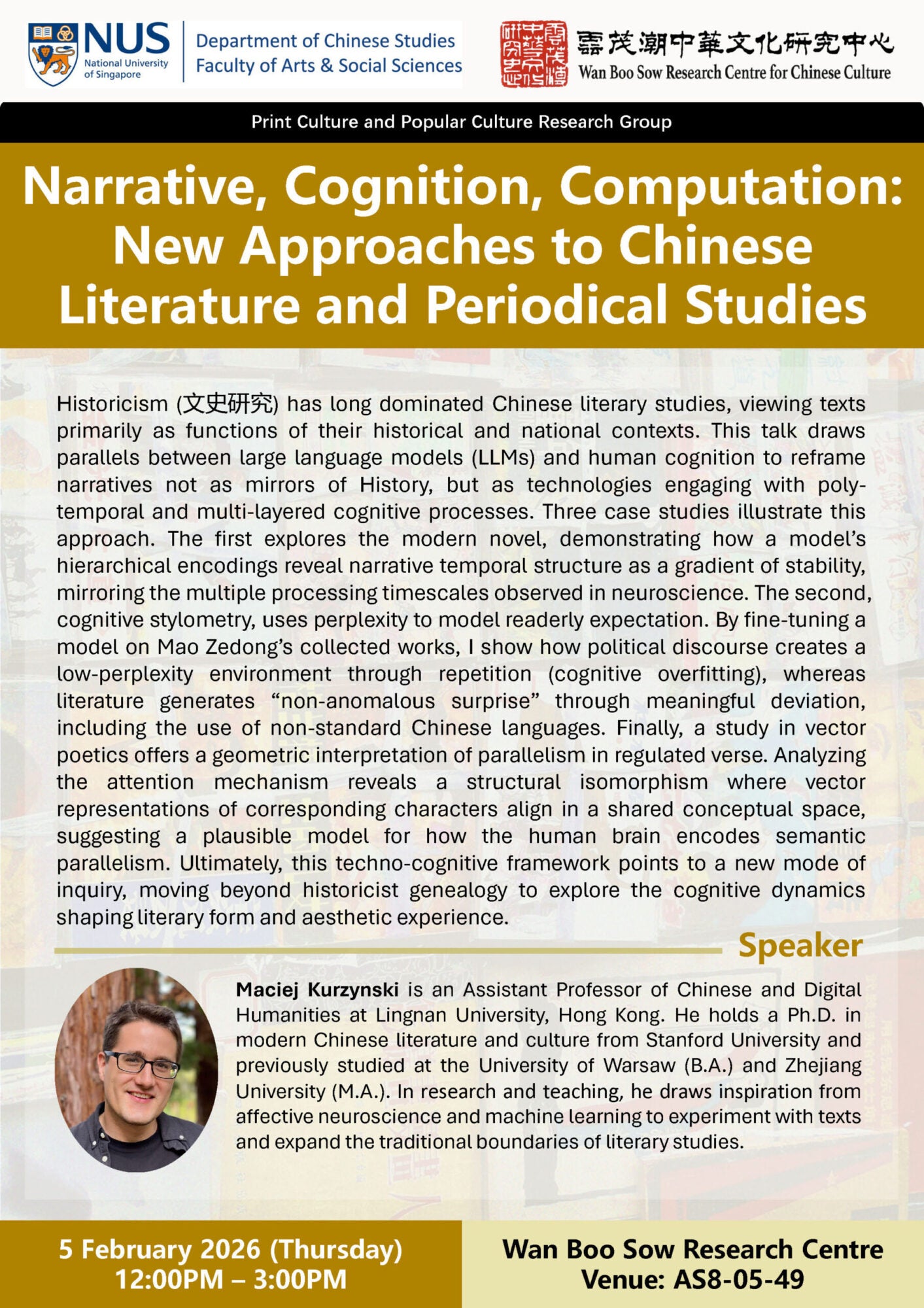
| 日期: | 2026年2月5日 |
| 时间: | 下午12时-3时 |
| 地点: | 雲茂潮中华文化研究中心 AS8-05-49 |
| 主讲人: | Dr Maciej Kurzynski |
| 语言: | 英语 |
Narrative, Cognition, Computation: New Approaches to Chinese Literature and Periodical Studies
Abstract
Historicism (文史研究) has long dominated Chinese literary studies, viewing texts primarily as functions of their historical and national contexts. This talk draws parallels between large language models (LLMs) and human cognition to reframe narratives not as mirrors of History, but as technologies engaging with poly-temporal and multi-layered cognitive processes. Three case studies illustrate this approach. The first explores the modern novel, demonstrating how a model’s hierarchical encodings reveal narrative temporal structure as a gradient of stability, mirroring the multiple processing timescales observed in neuroscience. The second, cognitive stylometry, uses perplexity to model readerly expectation. By fine-tuning a model on Mao Zedong’s collected works, I show how political discourse creates a low-perplexity environment through repetition (cognitive overfitting), whereas literature generates “non-anomalous surprise” through meaningful deviation, including the use of non-standard Chinese languages. Finally, a study in vector poetics offers a geometric interpretation of parallelism in regulated verse. Analyzing the attention mechanism reveals a structural isomorphism where vector representations of corresponding characters align in a shared conceptual space, suggesting a plausible model for how the human brain encodes semantic parallelism. Ultimately, this techno-cognitive framework points to a new mode of inquiry, moving beyond historicist genealogy to explore the cognitive dynamics shaping literary form and aesthetic experience.
Speaker Biography
Maciej Kurzynski is an Assistant Professor of Chinese and Digital Humanities at Lingnan University, Hong Kong. He holds a Ph.D. in modern Chinese literature and culture from Stanford University and previously studied at the University of Warsaw (B.A.) and Zhejiang University (M.A.). In research and teaching, he draws inspiration from affective neuroscience and machine learning to experiment with texts and expand the traditional boundaries of literary studies.